
SaskWatch Newsletter
Consumer Association of Saskatchewan Inc.
SaskWatch Newsletter Winter 2026
Travel Smart: Airline Scams and Frauds
by Billie Sarcauga
As air travel becomes increasingly accessible, opportunities for scams and fraud have expanded alongside it. The widespread use of online purchasing and digital information sharing has created new avenues for criminals to exploit consumers through phone calls, emails, mobile applications, and fraudulent websites. Travelers are particularly vulnerable during peak travel seasons or moments of urgency, such as flight delays or cancellations, when stress and time pressure weaken rational decision-making. In these situations, losses can occur within minutes, sometimes due to something as minor as a single incorrect letter in a website link or a counterfeit customer service phone number. Scammers capitalize on this vulnerability by impersonating trusted airline brands and travel agents, using sophisticated tactics such as false advertising, call-center style communications, and increasingly, artificial intelligence–generated messaging. (1)
Regulatory data shows a significant rise in reported cases and financial losses linked to these impersonation scams. As these practices continue to evolve, it is essential for consumers to recognize the warning signs. This article will examine common red flags associated with airline scams, highlight real-world cases involving victims, and outline practical steps travelers can take to protect themselves during airline transactions.
Call Centre and Customer Support Scams
With the growth of online information sharing, scammers now have easier access to travelers and their personal data. In some cases, fraud is as simple as advertising a fake phone number while attaching it to a well-known airline’s name.
In others, scammers initiate direct contact, impersonating airline representatives over the phone. Social media has also become a prime hunting ground: scammers monitor posts from frustrated travelers and reach out through fake accounts, posing as customer service agents offering assistance. Once contact is made, victims are often asked to provide sensitive information such as booking confirmation numbers, phone numbers, or banking details, or are redirected to spoofed websites designed to harvest personal data. This information can then be used to steal identities or rack up unauthorized charges on victims’ accounts. According to the U.S. Federal Trade Commission, airline impersonation scams have become increasingly common, exploiting consumers at moments of stress and urgency.(2)
One case involved Jeff Richardson, a Nova Scotia resident who booked a flight directly through the Air Canada website on October 22. After experiencing difficulty selecting his seat online, Richardson searched for a customer service number and called what he believed was Air Canada’s support line, beginning with 1-833. The individual who answered claimed to be an Air Canada representative, and Richardson provided his booking details and credit card information to reserve seats. However, Air Canada later confirmed to CBC News that the number did not belong to the airline. That same day, Richardson noticed a charge of more than $200 from a company called “AirReservation,” which is not affiliated with Air Canada, and was later notified that his flight had been cancelled. When he attempted to call the number again, the line appeared to be disconnected. Air Canada stated that the impersonator may have obtained enough personal information to cancel the booking. While Richardson recalls finding the number on what appeared to be the airline’s website, it remains unclear whether he encountered a spoofed site, a common tactic in which fraudsters create realistic copies of legitimate websites to mislead consumers. (3)
Baggage Scams
A newer form of airline-related fraud has emerged, targeting travelers through their baggage tags and boarding passes. Airlines have reported an influx of fraudulent claims in which scammers retrieve discarded adhesive baggage tags,typically attached to suitcase handles, and use the information printed on them to file false reports for missing items. These automated tags often contain sensitive details such as a passenger’s name, flight number, date of travel, and destination, and may also include the bag’s weight, place of origin, or booking reference. Reports circulating online suggest that scammers monitor airport terminals for travelers who throw these tags away, then retrieve them from trash bins and impersonate the passenger at baggage claims. (4) This not only results in financial losses for airlines but can also complicate legitimate claims made by the actual traveler if a fraudulent claim has already been submitted.
Boarding passes have also become a valuable target for fraudsters. Using barcode-scanning apps or simple “shoulder surfing” techniques while standing in airport lines, scammers can capture sensitive information such as a traveler’s booking reference or frequent flyer number. With this data, criminals may access ticketing accounts, steal personal information, hijack reservations, or even commit identity theft. (5)
Awareness of these tactics is a critical step toward prevention. While many travelers are vigilant about online security, physical items like baggage tags and boarding passes are often overlooked despite the sensitive information they contain. Keeping these items secure and disposing of them properly, such as by shredding rather than discarding them intact, can significantly reduce the risk of becoming a victim of fraud.
Red Flags Specific to Airline Scams
In response to the rise in airline-related scams, airlines have become more proactive in helping customers identify common red flags associated with fraudulent activity. Air Canada, for example, warns travelers to be cautious of requests for payment made outside official channels, pressure to act immediately, and demands for unusual payment methods such as gift cards, cryptocurrency, or wire transfers. These tactics are frequently used to create urgency and bypass a consumer’s rational decision-making.
Air Canada educates customers about common scam techniques, including phishing, smishing, and vishing. Phishing typically involves deceptive emails designed to “fish” for sensitive information such as passwords, bank account numbers, or credit card details. Smishing refers to fraudulent text messages that often contain misleading links leading to fake forms or malware downloads, while vishing, or voice phishing, involves phone calls, voicemails, or robocalls in which scammers impersonate legitimate businesses to obtain personal or payment information directly from the victim. Several warning signs may indicate these types of scams: messages are often unsolicited or sent from unknown or unverified sources, may contain misspellings, poor grammar, unusual formatting, or incomplete sentences, and frequently create a sense of urgency to prompt recipients to click links, open attachments, or provide sensitive information.
Air Canada advises customers to check its website for a list of trusted email addresses and to verify similar information with other airlines. Offers that seem unrealistic or promise automatic financial gain should also be treated with suspicion, as they are often designed to lure victims into a false sense of security. (6)
Travelers are urged to remain vigilant when encountering advertisements on search engines or social media that claim to offer airline assistance, services, or deals. These ads can be deceptive and may direct users to fraudulent phone numbers posing as airline call centers. To reduce the risk of falling victim to these scams, passengers should always rely on official and verified airline websites, apps, and contact channels when making bookings, managing reservations, or seeking customer support.
Protect Yourself from Airline Fraud
To reduce the risk of travel-related fraud before booking, experts recommend making reservations directly through official airline websites or trusted online travel agencies (OTAs). Travelers should rely on verified airline contact details and use official airline mobile apps rather than phone numbers or links found through online ads or social media. Enabling two-factor authentication on airline and loyalty program accounts adds an extra layer of security, and paying with a credit card—rather than debit or alternative payment methods—offers additional consumer protection in the event of fraud or unauthorized charges. (7)
Protecting personal information remains important throughout the travel journey, not just during booking. Boarding passes, whether digital or physical, should be kept secure and only displayed when required by airline staff. Travelers are advised not to post images of boarding passes or baggage tags on social media, as the information they contain can be exploited by scammers. Boarding passes and baggage tags should never be left on the plane or casually discarded at the airport; instead, they should be disposed of safely, preferably shredded, once the traveler has reached their destination.
Additional precautions can further reduce exposure to fraud. Travelers should carry only essential identification documents and devices, leaving unnecessary electronics and sensitive items at home when possible. Air Canada recommends, for example, leaving passports behind when flying domestically.
It is also advisable to avoid accessing bank accounts, health records, or other sensitive information while connected to public Wi-Fi networks. Public USB charging ports should be avoided as well, as they can be compromised to extract data from devices; bringing a personal portable charger is a safer alternative. (8)
If you believe you have been scammed, it is important to act quickly to limit further damage. Start by contacting the airline directly through its official website, mobile app, or verified customer service number to report the incident and secure your booking. You should also notify your bank or credit card issuer immediately so they can block unauthorized transactions, reverse charges where possible, and monitor your account for suspicious activity. Reporting the scam to consumer protection agencies can help authorities track fraud trends and prevent others from becoming victims. Finally, change passwords for any affected accounts and strengthen their security, including enabling two- factor authentication, to reduce the risk of further compromise. (9)
Sources:
1. Airline impostor scams exploit digital gaps and traveler stress. Hospitality.today. (2025, December 19). https://www.hospitality.today/article/airline-impostor-scams-exploit- digital-gaps-and-traveler-stress
2. Puig, A. (2024, July 25). Scammers impersonate airline customer service representatives. Consumer Advice. https://consumer.ftc.gov/consumer-alerts/2024/07/scammers-impersonate-airline-customer-service-representatives
3. Grillo de Lambarri , G. (2025, June 14). He thought he was calling Air Canada. the airline says it wasn’t them . CBC news. https://www.cbc.ca/news/canada/nova-scotia/air-canada-refund-1.7559180
4. Himmelsbach, V. (2026, January 8). New scam targeting airline passengers results in a reported influx of fraud. How it works and why your baggage tags are key. MSN. https://www.msn.com/en-ca/money/topstories/new-scam-targeting-airline-passengers-results-in-a-reported-influx-of-fraud-how-it-works-and-why-your-baggage-tags-are-key/ar-AA1TL1Aq
5. Ibid.
6. Air Canada – Anti Fraud Information Guide. The Air Canada Cybersecurity Centre. (n.d.). https://www.aircanada.com/ca/en/aco/home/book/travel-news-and-updates/telephone-and-email-scams.html#/
7. Ibid.
8. Himmelsbach, V. (2026, January 8). New scam targeting airline passengers results in a reported influx of fraud. How it works and why your baggage tags are key. MSN
9. Travel fraud: How to protect yourself before you book a vacation. RBC Wealth Management. (2025, March 20). https://www.rbcwealthmanagement.com/en-ca/insights/travel-fraud-how-to-protect-yourself-before-you-book-a-vacation
Spotlight on Seniors – Highlights and Insights
by Lou Hammond-Ketilson
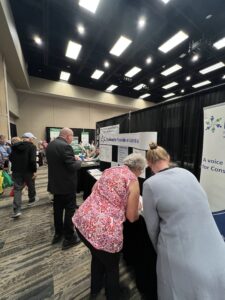
Once again Seniors from across Saskatoon and surroundings were treated to an exceptional trade show specific to their needs. Ninety exhibitor tables staffed by 240 exhibitors and staff provided information on a wide range of topics. Sixty eight volunteers and entertainers kept activities running smoothly and the audience tapping their toes.
The Consumer Association of Saskatchewan was pleased to have a table at the event again this year. Spotlight on Seniors is an excellent opportunity to gather information regarding consumer issues specific to our senior population. As in previous years, scams topped the list of issues of greatest concern, and we were happy to share the numerous resources available to assist in preventing this vulnerable demographic from being exploited.
Spotlight on Seniors is also an excellent opportunity to share broader information regarding consumer rights, and ways to access assistance when issues do arise. Our door prize of a bouquet of flowers was very popular. Of the 510 attendees who stopped to ask questions or share an experience, fifty one entered the draw. We look forward to attending again next year.
Why Price Transparency Matters
by Billie Sarcauga
Visible pricing is essential for fair shopping. Consumers rely on posted prices to make informed decisions and manage their budgets. When prices aren’t clearly displayed, shoppers waste time, feel pressured at checkout, lose trust in the store, and have less bargaining power, hurting both consumers and businesses.
Recently, employees at a Canadian arts-and-crafts chain, Michaels, say customers are constantly asking why price tags are no longer on display, a new tactic that retailers are experimenting. Depending on the case, individual prices are either removed or from the shelves. This affects the consumer experience in physical stores, as it is more transparent in online shopping. Without the visible price tags, it becomes a confusing and frustrating process. Consumers have to scan items to know what they cost or seek store attendants for assistance. Others will completely skip these options and opt out of the purchase. (1)
Without price information, this removes the ability for consumers to make informed decisions. Additionally, they skip comparing prices from various stores due to the increasing efforts. It catches them off guard when they see the price at the till, thus, limiting the ability to decide on their purchase. Most of all, they lose trust in the business, which may cause a decrease in competitive markets.
Legal Price Display Requirements
In Canada, consumer protection frameworks like the Competition Act require retailers to display accurate pricing, and some provinces impose explicit visible-price rules. Many retailers also subscribe to the Scanner Price Accuracy Code, which compensates customers when checkout prices exceed listed ones. The Competition Act prohibits double ticketing, meaning a retailer can’t charge more than the lowest clearly displayed price on a product. Through the voluntary Scanner Price Accuracy Code, major Canadian retailers agreed to compensate customers if scanned prices exceed advertised ones. (2)
These measures protect fairness through price visibility. Without it, trust and accountability erode, and digital tools, such as comparison shopping apps, help restore transparency when price tags disappear.
Transparency With Price Comparison Apps
Price comparison apps let users compare prices across retailers, both online and sometimes in-store, often by barcode scanning or searching product names. They pull real-time pricing data so shoppers can find the lowest price or best deal quickly without manually visiting many sites or stores. Here’s an overview of some widely used apps and services that help consumers compare prices (3):
ShopSavvy:
- Scan barcodes or search for products to check prices online and in nearby stores
- Highlights sales at major retailers
- Compares prices across a wide range of sellers
- Includes a price history graph to track price changes over time
BuyVia:
- Barcode scanner to find best prices in nearby stores or online
- Lists coupons and deals
- Allows price alerts for selected items
Flipp:
- Displays store flyers in an in-app format
- Lets you select favorite stores for personalized deal viewing
- Search deals by product name
- Watch list feature with notifications for price drops
MyCartSavings:
- Tracks prices in stores and online
- Notifies you when prices drop to your preferred amount
Price.com:
- Compare prices by searching, scanning a barcode, or uploading/snapping a photo
- Offers price alerts for target prices
- Also available as a website and browser extension
Comparison shopping apps help consumers save money by identifying the best available prices both online and in local stores, making it easier to avoid overpaying while still choosing high-quality products. They also reduce search time by aggregating pricing information in one place, eliminating the need to visit multiple websites or stores. With tools like price histories and alerts, shoppers can make more informed decisions about when to buy, not just what to buy. These benefits are especially valuable for mobile shoppers, who can quickly compare options and complete purchases with just a few taps on their smartphones. This level of convenience supports a seamless shopping experience that meets the expectations of today’s consumers and benefits ecommerce businesses alike. (4)
While comparison shopping tools are useful, they do have limitations. Not all retailers or products are included in every app or website, as some small businesses cannot afford listing fees and others choose not to participate in order to direct customers to their own platforms. Although many services claim to be independent, results may be influenced by sponsored or affiliate listings that are promoted over lower-priced options. Price accuracy can also be an issue, since prices often change quickly and comparison tools do not always update in real time, particularly in industries with fluctuating or limited inventory. Technical delays or incomplete data feeds may result in outdated pricing or unavailable products, which can frustrate users when a deal turns out to be more expensive or sold out at checkout. (5)
Conclusion
As retailers experiment with less visible pricing models, the need for transparency in shopping has never been more important. Clear, accessible prices empower consumers to make informed decisions, manage their budgets, and trust the businesses they support. When price tags disappear or become difficult to find, that transparency weakens, shifting time, effort, and uncertainty onto the shopper while diminishing accountability in the marketplace.
Legal protections and voluntary pricing codes in Canada reinforce the principle that visible pricing is essential to fairness. However, as retail environments evolve, digital tools are increasingly filling the gaps. Price comparison apps restore access to information by allowing shoppers to quickly compare options, track price changes, and set alerts, ensuring they remain informed even when in-store pricing is unclear.
Ultimately, transparent pricing benefits everyone. Consumers gain confidence and control over their purchases, while businesses build trust and encourage healthy competition. Whether through clear in-store displays or reliable digital tools, maintaining price visibility is key to preserving fairness, accountability, and consumer power in a changing retail landscape.
Sources:
1. Bednar, V. (2025, December 24). Opinion: Why shops are removing price tags, and why this is bad. The Globe and Mail. https://www.theglobeandmail.com/business/commentary/article-why-shops-are-removing-price-tags-and-why-this-is-bad/
2. Ibid.
3. Steele, C. (2024, November 14). 6 price comparison apps to help you get the best deals. PCMAG. https://www.pcmag.com/picks/best-price-comparison-apps-for-shopping
4. Paynton , G. (2024, August 15). The importance and benefits of comparison shopping. ShipNetwork. https://www.shipnetwork.com/post/the-importance-of-comparison-shopping
5. Jackson, S. (2014, May 2). 6 downsides of comparison websites. Money Dashboard. https://www.moneydashboard.com/blog/6-downsides- of-comparison-websites
A-Z Index of Common Scams by the Canadian Anti-Fraud Centre
A
- Air duct cleaning scams – Fraudsters offer unsolicited air duct cleaning services, often over the phone, perform poor or no work, and overcharge customers.
- Asian community phone scams – Callers target members of Asian communities, often posing as authorities and threatening arrest or deportation to extort money.
B
- Bank investigator scams – Scammers impersonate bank officials and claim suspicious activity to trick victims into sharing banking details.
- Bomb threat scams – Threats of violence are used to extort money or cause disruption.
- Business executive spoofing & wire fraud –Criminals impersonate company executives to trick employees into transferring funds.
- Business grants & loans scams – Fake offers of funding that require upfront fees or personal information.
- Business opportunity scams – Promises of high-profit ventures with little risk that rarely deliver returns.
- Business proposal scams – Fraudsters send fake contracts or proposals to steal money or sensitive data.
C
- Canada Revenue Agency (CRA) scams – Imposters claim you owe taxes or are owed refunds and demand payment or personal details.
- Car wrapping scams – Fake companies offer payment for advertising on vehicles, often involving counterfeit cheques.
- Card-not-present fraud – Unauthorized credit card transactions made without the physical card.
- Charity scams – Fake charities solicit donations, especially after disasters.
- Collection agency scams – Fraudsters pose as debt collectors and pressure victims into paying fake debts.
- Continuity scams – Victims unknowingly agree to recurring charges after a free or low-cost offer.
- Counterfeit bank notes – Fake currency is passed off as legitimate.
- Counterfeit merchandise – Fake goods sold as authentic products.
- COVID-19 scams – Fraud related to testing kits, benefits, or vaccines.
- Cryptocurrency scams – Fake investment platforms or wallets designed to steal digital assets.
D
- Denial-of-Service (DoS/DDoS) scams – Threats or attacks that disrupt systems unless payment is made.
- Donation scams – Fraudulent appeals for donations to fake causes.
E
- Emergency scams – Scammers claim a loved one is in immediate danger and needs money.
- Explicit video scams – Threats to release fake or real compromising material unless paid.
- Extortion – Criminals threaten harm, exposure, or legal action to obtain money.
F
- Fake grants – Victims are told they’ve qualified for a grant but must pay fees first.
- False billing scams – Fake invoices sent for services never ordered.
- Financial agent fraud – Scammers pose as financial advisors to steal funds.
- Financial industry client spoofing – Fake communications appear to come from legitimate financial institutions.
- Foreign lottery scams – Victims are told they won a lottery they never entered.
- Foreign money offers – Advance-fee scams promising access to overseas funds.
- Franchise opportunity scams – Fraudulent franchise offers promising guaranteed success.
See the full A-Z index of common scams on the Canadian Anti-Fraud Centre’s website:
https://antifraudcentre-centreantifraude.ca/scams-fraudes/azindex-eng.htm
Saskatchewan Residents Urged to Stay Informed Before Investing
Being an informed investor is one of the best ways to protect yourself from investment fraud. Saskatchewan residents have been encouraged to make sure they are fully informed before investing their money. While most investment advisers are honest and work in your best interest, it’s still important to be careful about who you choose to trust. Before you invest, follow these simple steps:
1.Check the National Registration Search: https://info.securities-administrators.ca/nrsmobile/nrssearch.aspx
2.Check disciplinary history
3.Check the news and search the internet
4.Check available tools and resources
5.Check investor alerts: https://fcaa.gov.sk.ca/whats-new/alerts
Sources:
1. Financial and Consumer Affairs Authority of Saskatchewan. (n.d.). Check before you invest. https://fcaa.gov.sk.ca/consumers-investors-pension-plan-members/investors/check-before-you-invest
2. Canadian Securities Administrators – Are They Registered?: Canadian Securities Administrators. (n.d.). Are they registered? https://www.securities-administrators.ca/investor-tools/are-they-registered/
Keurig Recyclable K-Cup Pods Class Action Settlement Approval
Keurig has agreed to a $1.85 million settlement, according to a Jan. 12 notice from claims administrator Eqitas. The class action, filed on Oct. 22, 2025 by Nancy Buis, alleged Keurig misled Canadian consumers about the recyclability and disposal of its pods and brewers.
If you are part of the settlement, you may be able to get some money. How much you receive depends on what you bought and whether you have proof of purchase (ex. a receipt).
If your claim is about Pods:
- If you do not have a receipt, you can receive up to $7 total per claim form.
- If you do have a receipt for at least one Pod bought during the class period, you can receive:
- 50 cents for every 10 Pods you bought (rounded up to the nearest 10), up to a maximum of $50, or $7 total (you will receive whichever amount is greater).
If your claim is about Brewers:
- If you have a receipt for at least one Brewer and a receipt for at least one Pod bought after the Brewer, and both were purchased during the class period, you can receive up to $25 total per claim form.
Y ou can only submit one claim form, even if you are claiming for both Pods and Brewers.
Claim forms can be downloaded at:
www.kcupsrecyclingsettlement.ca
Sources:
1. Daily Hive. (2026, January). Keurig class action settlement in Canada [Article]. Daily Hive. https://dailyhive.com/canada/keurig-class-action-settlement-january-2026
2. Eqitas Class Action Claims Administration. (2026). Welcome to the Keurig Recyclable K-Cup Pods Class Action Settlement website. https://kcupsrecyclingsettlement.ca/K-Cup-Settlement/Welcome
SaskWatch Winter 2026
Published by:
Consumer Association of Saskatchewan
Contributors:
- Billie Sarcauga
- Lou Hammond Ketilson
CASK Board of Directors
President: Lou Hammond Ketilson
Vice-President: Patricia Lewis
Secretary: Courtney Pickard
Treasurer: Patricia Lewis
Check us out on Facebook:
facebook.com/ConsumerSask/
Instagram:
@consumerassociationsask
Phone
(306) 242-4909
For inquiries and complaints, please call us.
Feel free to email us with any questions or concerns
Mailing Address
Consumer Association of Saskatchewan Inc. (CASK)
P.O. Box 7344
Saskatoon, SK
S7K 4J3
Send us mail at the address above for assistance.
Make a Real Impact: Volunteer for Consumer Advocacy
Join Our Volunteer Team Today! Your time matters – even a few hours a month is greatly appreciated.
The Consumer Association of Saskatchewan exists because of the generous commitment of its volunteers.